Author: kiara

Helping seniors find the most suitable accommodation – Part 1

Many seniors and others in need do not feel ready to leave their home for an institutional setting but do need support to remain at home. Trying to follow their wishes and choose the least restrictive approach first is advisable. However, family members must be realistic about their loved ones’ abilities and should assess their senior’s ability to age in place.

To determine if an elderly person can continue living at home requires examining all aspects of their present housing situation and how each one affects their safety and quality of life is key.

  1. Medication management should be assessed: Do they remember to take their medications at prescribed doses and times?
  2. Meal preparation: Is it possible for them to cook for themselves? Are they preparing and eating balanced meals? Are they able to safely operate kitchen appliances?
  3. Safety and mobility: Do they have difficulty getting around the home or taking stairs? Have they fallen in the home? Do they have a plan in place to call help in case of an emergency? If mobility is an issue, can the home be equipped with safety devices like grab bars or an emergency response system and would the senior person be open to using them?
  4. Personal hygiene. Can they autonomously take care of their personal hygiene routine (bathing often enough, grooming adequately, laundering their clothes and linens)?
  5. Transportation: Are they still driving? Are they safe behind the wheel?
  6. Socialization: Are they participating in activities, seeing friends and exercising or are they isolated from others most of the time? Are they showing signs of depression?
  7. Home management: Is the house clean or in general disarray?
  8. Financial management: Are their bills paid on time?

Who qualifies to assist seniors at home?
Professional agencies like Premier Home Care help seniors continue to stay and function at home with the support of qualified caregivers who go through initial and ongoing training. Caregivers at Premier Home care may have different certifications such as Alzheimer care, cancer care, diabetes, heart care and others. They are interviewed in person and if then selected, they undergo references and a criminal background check performed by an independent company.

What is the process?
Mark Wathen, co-owner of Premier Home Care, explains that once the company completes its free client assessment and home safety inspection for fall prevention and bathroom safety, they meet again with all decision makers involved to present their personalized recommendations. A customized care plan is designed outlining all the agreed upon services and the weekly schedule (3-hour minimum shift).

Services provided
The caregivers provide non-medical homecare: companionship (including reading together, games and puzzles, help with, cooking together and watching TV), meal preparation, light housekeeping, grooming & dressing, transportation to appointments or errands, medication reminder and other activities of daily living.

Quality control
Mark mentioned that in order to keep track of the quality of care they come to the home for unannounced visits, check the Care Plan book and the log, and communicate with the client and the family directly. Time keeping is automated with software specifically designed for the home care industry, so they always know when a caregiver’s shift starts and ends and are immediately alerted if there are any discrepancies. There is an application for smartphones, so the client always has access to the caregiver and schedule.

Who can benefit from such services and where?
The clients are primarily seniors who want to remain safe and independent in their homes for as long as possible. Whether home is the family house, a condo, a senior’s residence or an assisted living facility, we can provide our services wherever they are required. Once they start getting help with activities of daily living, seniors can remain in their current residence for years, surrounded by their memories, family and friends, more affordably than moving to an increased care facility.

The cost factor
Generally, rates vary between $23-$28 per hour for “standard” care for an individual. Usually there are additional costs for couples and/or special Alzheimer care. Many companies will require a minimum of 3 or 4 hours per shift – this is in consideration of the caregivers having to travel to and from the client’s residence.

For people aged 70 and over, choosing to remain at home has never been so easy. In Québec, you can potentially receive up to 35% of your eligible expenses as a tax credit related to home care services. Most services and products are eligible.

Sometimes home care can last only for a limited time due to changes in the senior’s health condition or additional needs. On other occasions the answers to questions 1-8 (at the beginning) may indicate social isolation, apathy, or loneliness which may lead to prefer life at an active residence. Once the choice has been made to move to a seniors’ residence the search for the appropriate residence begins. More often than not the senior and the family can feel overwhelmed by this process, by the need to ask the right questions and know what to look for and compare before meeting a final decision. In part 2 of this blog we will try to offer some insight into the differences between residences, cost, and levels of care so you will feel better informed and know what to expect and plan for.

Useful links:

The value of bonds as a tactical investment

Having a balanced portfolio can help make portfolios more risk resistant and allow them to succeed in numerous market cycles. Bonds are one of the most valuable tools investors have to diversify and balance their portfolio. In this month’s blog, we explain what bonds are, how they are traded, why they fluctuate, and most importantly how they can help your portfolio.

What are bonds?

Governments and corporations often need to raise money for their operations. These operations can include anything from building infrastructure to launching new products. One of the ways a company or government can raise that money is by issuing bonds. Bonds are effectively IOUs whose face value, the principal, must be repaid on a maturity date. Bonds also include a coupon, which is the interest investors will earn from the bond and which is calculated annually as a percentage of the principal.

The four types of bonds are corporate, government, municipal, and mortgage. Though they are often considered safe investments, their prices can fluctuate for several reasons.

Bonds on the Secondary Market

Similar to the way stocks are traded, after a bond is issued on the primary market, it can be traded between investors on the secondary market, especially corporate bonds. Because of the variety of issuers and maturity dates, secondary market bonds are sold over the counter (OTC) instead of on an exchange.

The value of having access to a secondary market is that it gives bonds liquidity, which can be a very valuable addition to their secure reputation.

Why the fluctuations?

There are three primary reasons bonds may fluctuate: interest rates, the inflation rate, and economic outlook.

Interest rates and bond prices have an inverse relationship, meaning that when interest rates fall, bond prices rise, and vice-versa. This occurs because, if interest rates rise above a bond’s coupon, purchasing that bond will no longer be an attractive investment. Because potential investors could receive a better rate from banks, there will be less demand for bonds on the secondary market.

The inflation rate also has an inverse relationship with bond prices. Because a rise in the inflation rate means a decrease in a given dollar’s purchasing power, it means that if inflation rates rise more than expected, the return from a bond will be worth less in current dollars. However, the inverse is also true and can lead to a greater-than-anticipated purchasing power from the dollars returned by a bond.

Economic reports and outlook that can affect bonds include the employment rate and GDP growth, among other forecasts. And these forecasts can be the greatest force for fluctuating the bond market, as hope or fear influence investors’ decisions about future investments. If the numbers being reported are much better or much worse than what was expected, a big move in the bond market, as in most markets, can be expected.

Because bonds are seen as a safe investment, during volatile times or when there is negative economic news, investment-grade bond prices will rise. High-yield bonds often have more risk and therefore do not behave in the same way. Investors respect the safety of investment-grade bonds and may therefore choose them over investments with greater risk. On the other hand, when the economy is booming and there is good employment data, bond prices may suffer as investors seek to cash in on the greater market’s success.

How this affects you

At Rothenberg, we take a conservative approach to investing. Our Balanced Portfolio philosophy means that we aim to make our clients’ portfolios successful by matching it to their risk tolerance level and hopefully creating stable growth. Investment-grade bonds are a valuable tool in a balanced portfolio.

To learn how bonds can be useful to your specific portfolio, make an appointment with one of our Wealth Advisors. Please call 514-934-0586 (Quebec) or 1-800-456-0949 (Alberta).

Why Most Retirement Plans Fail?

By: Robert Rothenberg, CFA, CIWM, FCSI

When new prospects come to see us, they typically ask about our rate of return assumptions when projecting their financial success in retirement.

Many individuals look at the long-term average for the stock market at 10% or a blend of fixed income and equities and average 7% over retirement when calculating the income and portfolio growth of their investments.

When people are in the accumulation phase of their life and saving money on a regular basis to fund their retirement, using an average rate of return is fine as it doesn’t matter whether your portfolio performs well at the start and underperforms towards the end or underperforms at the start and excels at the end.

In retirement, many other factors come into play when determining if your income is sustainable. One of the major factors is the sequence of returns.

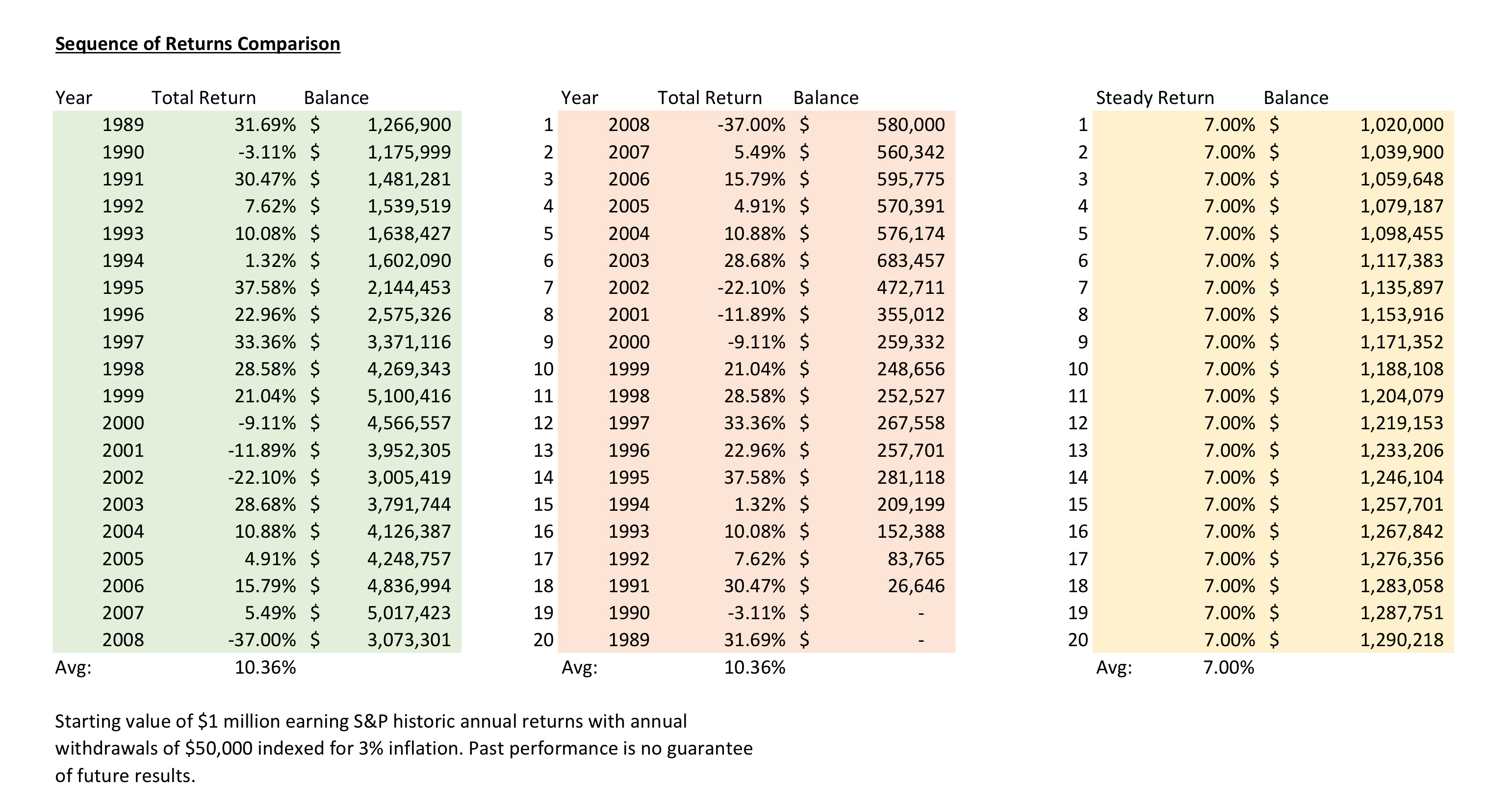
Poor returns at the start of retirement while withdrawing funds may make it extremely difficult to ever catch up. Bad timing can show that funds can be exhausted using a 5% withdrawal rate and an average rate of return of 10% in less than 20 years while the same withdrawal rate and a 7% average rate of return can have more funds than what an investor had initially when returns are strong at the onset.

The illustration shows three different examples. The first shows a retiree lucky enough to retire in 1989 having started with $1 million taking out $50,000 per annum indexed to inflation with their funds growing to over $3,000,000 in 20 years.

The second example shows the same retiree with the sequence of returns reversed with the same $1 million and the same withdrawals. This retiree would run out of money in 18 years even with an identical average return.

The third example shows a retiree earning 7%, which is considerably less than 10%, but having close to $1.3 million after 20 years.

A cash wedge strategy would be highly recommended when starting the withdrawal phase of your life. Having 18 – 24 months of income invested in cash equivalents and short-term bonds which is used to fund your withdrawals early in retirement will help ensure success if the market declines dramatically early on.

By having this cash wedge, you won’t need to sell any of your equity holdings at low prices to fund your retirement allowing time for them to recover.

In retirement, consider less volatile stocks with decent dividends or dividend growth for most of your equity exposure. When the 2008 meltdown occurred, stocks with less volatility than the overall market performed significantly better in aggregate.

The same can be said for inflation, which has been a non-factor for the better part of a decade. The historical average has been slightly more than 3% in North America with average annual rates in the 1 – 2% range. Indexing your withdrawals to inflation early on at higher rates will have a similar result as poor returns early in your retirement.

Try to keep the increase of your withdrawals below the inflation rate as this can help sustain your capital as most illustrations do index income withdrawals fully with inflation.

Taxation and costs also play a part in the success of your retirement. Maximizing contributions to Tax Free Savings Accounts is a must for individuals with non-registered funds. This can reduce the income tax payable on interest and dividend income along with capital gains substantially.

Consider pulling out some of your RRSP funds prior to age 71 if you are in a relatively low tax bracket to offset paying a higher amount of tax down the road.

Many individuals who do not have a private pension plan should consider taking out a small RRIF or annuity at age 65 to take advantage of the $2000 pension income credit.

Costs can also affect a successful retirement and eat away at returns. Ensure your overall costs are reasonable for the advice you are receiving.

By reviewing your retirement plan regularly taking into account the variables mentioned above will help you succeed where many fail.

Tax-Loss Selling and Year-End Checklist

We are here to provide you with a checklist to ensure you get the most out of tax credits, deductions, and benefits. But first, we want to get more in depth about tax loss selling.

What is Tax-Loss Selling?

Tax-loss selling means selling an investment with accrued losses at year-end, allowing you to offset capital gains realized with other investments. Net capital losses can be carried back three years or carried forward indefinitely. Tax-loss selling therefore enables investors to mitigate the impact of capital gains taxes.

Superficial Loss Rules

When you sell an investment at a loss, if you, your spouse, your company, or a trust in which you have a major interest, purchase and still own an identical investment within 30 days of the sale, then the capital loss is added to the cost base of the purchase. This includes re-purchasing the same company or a fund tracking the same index. Professional advice may be needed to determine whether certain products are considered identical.

Foreign Currency Tax Loss Selling

Foreign currency fluctuations are another important consideration when tax-loss selling. The gain or loss will be different once the foreign exchange is taken into account. It is even possible that when calculating between two currencies, what appeared to be a loss may end up being a capital gain, and vice versa. Before selling to take losses, it is extremely important to calculate foreign currency exchange rates.

The Rest of the Year-End Checklist

While tax-loss selling can be an important tool, it is far from the only thing to consider before year-end. Here is a handy checklist with some other steps to take:

Pension income splitting — Those who receive a pension may be eligible to split up to 50% of eligible pension income with a spouse

Guaranteed income supplement — If you received the guaranteed income supplement or allowance benefits under the old age security program, you can renew the benefit by filing by the deadline.

Registered retirement savings plan (RRSP) — You have until December 31 of the year in which you turn 71 to contribute to your RRSPs.

Goods and services tax/harmonized sales tax (GST/HST) credit — You may be eligible for the GST/HST credit, a tax-free quarterly payment that helps offset all or part of the GST or HST you pay. To receive this credit, you must file an income tax and benefit return every year.

Medical expenses — You may be able to claim eligible medical expenses that you paid, provided the expenses were made over the 12-month period ending in 2018 and were not previously claimed. This can include amounts claimed for attendant care or care in an establishment.

Age amount — If you are 65 years of age or older on December 31, 2018, and if your net income was less than $83,000, you may be able to claim up to $7,125.

Public transit amount — You may be able to claim the cost of monthly or annual public transit passes for travel within Canada on public transit in 2018.

Pension income amount — You can claim up to $2,000 if you report eligible pension, or annuity payments on your tax return.

Registered disability savings plan (RDSP) — This savings plan can help families save for the financial security of a person who is eligible for the disability tax credit. RDSP contributions are not tax deductible and can be made until the end of the year in which the beneficiary turns 59.

Disability amount — If you, your spouse or a dependent have severe and prolonged impairments in physical or mental functions and meet certain conditions, you may be eligible for the disability tax credit (DTC).

Family caregiver amount — Those caring for a dependent with impairment in physical or mental functions may be able to claim up to $2,000 when calculating certain non-refundable tax credits.

Financial Terms Glossary

Have you noticed that in the investment industry there are so many acronyms and terms you have never heard of? We would like to de-mystify our business! So we have included a glossary of some of these terms in this eNewsletter. Let’s start with these ten!

Exchange Traded Funds (ETFs)

Exchange traded funds (ETF) are securities that track other assets or indexes, meaning that they own underlying assets such as stocks or bonds, and divide ownership into units. ETF unit holders are entitled to profits such as interest or dividends, and their value can appreciate over time. Though they are pooled funds, they trade like a common stock on a stock exchange.  That means the can be bought and sold throughout the day, thereby offering liquidity and diversity. They generally have lower fees than mutual funds.

Principal Protected Notes (PPNs)

Principal protected notes (PPN) are structured notes that guarantee the investor’s initial investment, and offer growth or income based on the performance of the underlying assets. PPNs are ideal for investors wishing to help protect their investments while participating in market movement.  Investors must hold PPNs until maturity in order to receive the full payout.  This means that investors’ money will be tied up for longer periods of time, and early withdrawals may be subject to withdrawal charges.

Principal At-risk Notes (PARs)

Principal At Risk Notes (PARs) are a type of structured note that can provide more growth or income than a PPN, but with risk to the initial investment, hence their name. PAR notes often have additional features, such as limited capital protection or accelerated returns, and like PPNs must be held until maturity in order to receive the full benefit of the note. Other restrictions may apply, such as an upside cap.

Mutual Funds

A Mutual fund is a pooled investment composed of stocks, bonds, and similar assets. They are operated by managers who invest the fund’s capital to try to produce capital gains and income for the fund’s investors. Mutual funds provide a way for investors to access the stock market and the potential and diversity of a wide range of financial products with a relatively smaller amount to invest.  There are many different kinds of mutual funds, with different investment styles, asset mixes and geographic allocations.

Preferred Shares

Preferred shares are fixed income securities issued by companies that pay dividends to shareholders.  Preferred shareholders get paid before common stock dividends are issued.  They are also entitled to be paid ahead of common stock holders in the event the company goes bankrupt. Preferred stock shareholders do not hold any voting rights.

Common Stock

Common stockholders own a portion of a company, and are usually given voting rights.  Stockholders partake in the profits of a company both via dividends and capital appreciation, if the value of the shares increase. There is more risk in holding the common stock of a company, but there is also potential for greater returns than holding preferred shares.

Real Estate Investment Trusts (REITs)

Real estate investment trusts (REITs) are trusts that own, operate, or finance real estate. REITs often trade on major exchanges like other securities and offer an opportunity to take part in real-estate investing. The REIT income comes from a variety of income-producing real estate, from residential housing to shopping malls to office buildings, and often specialize in a specific sector, such as healthcare.

Bonds

Bonds are debt securities where the issuer – the company or government that is borrowing – owes the bond holder. They pay interest until the maturity date at which point the capital amount would be repaid. Interest is usually payable in semi-annual intervals. Bonds are typically liquid and can be traded on the secondary market.

The primary difference between stocks and bonds is that stockholders are owners and bondholders are considered as lenders. Bondholders have priority and will be repaid in advance of stockholders in the case of bankruptcy. Furthermore, bonds have a maturity date, whereas stocks remain outstanding indefinitely.


Guaranteed Investment Certificates (GICs)

Guaranteed Investment Certificates (GICs) are Canadian investments, offered by trust companies or banks, that provide a guaranteed interest rate of return over a fixed period of time. Because the invested amount and the interest on GICs are fully guaranteed, they are considered a safe investment.  The Canada Deposit Insurance Corporation (CDIC) guarantees the repayment of interest and capital in the unlikely event of bankruptcy of the financial institution up to the amount of $100,000 per person per institution (check CDIC.ca for more details).

Guaranteed Life Annuities

Life Annuities are financial products that pay out a fixed amount of income.  Regardless of what happens to the stock markets, and/or interest rates, the Life Annuity will continue to pay out a fixed amount, making the Annuity a reliable means of securing a steady cash flow.  Life Annuities are offered through Life Insurance companies, and they can not be changed once started.  The payments will continue for the entire life of the annuitant and his/her spouse if applicable.  Guaranteeing a minimum number of payments as a way to protect the estate is always recommended.

While it is important that you are aware of some of this terminology it is even more important that you speak with your Wealth Advisor.  He or she can help you through this jungle!

Tips for Canadian Snowbirds

There are a lot of things to take into consideration when you’re leaving the country for an extended period of time. These tips will help make you with preparation, travel, and driving basics. Once everything taken care of, all that’s left is getting to your destination safely. From there you can enjoy the sun and warm weather stress and worry-free.

Leaving your house vacant for more than 30 days

Each homeowner insurance provider is different but all of them have rules in place regarding steps that you must take if your house, condo or apartment is going to be vacant for a specified length of time – usually 30 days. A trusted neighbor, friend or family member who routinely checks in on your house could help mitigate any potential problems—such as water damage resulting from a burst pipe. It is wise to call your insurance provide to review your policy so you can leave with peace of mind.


Tips before you leave 

  1. Pack your passport, but first renew it if it’s due to expire during your time away.
  2. Make 2 photocopies of all your cards and documents. Pack one set and leave a copy with a trusted neighbour, friend or family member.
  3. Let your bank and credit card companies know that you’ll be leaving the country.
  4. Consider purchasing an international phone plan to save on costly roaming fees.
  5. Cancel any regular deliveries and forward your mail.
  6. Unplug all unnecessary electronics and appliances in your home. Shut off the water.
  7. Make it seems as if someone is home. Arrange someone you trust to collect mail or flyers that land at your front door. Install timers on indoor and outdoor lights and hire someone to clear snow from your driveway, sidewalk and path after each snowfall.
  8. Call your telephone, cable, Internet and/or satellite provider to temporarily suspend your service. However, make sure this doesn’t interfere with your home monitoring system, if you have one.
  9. Store valuables that you’re not taking with you in a safety deposit box.
  10. Do not post your travel plans on social media sites. You don’t want to publicize that you’re away from the house.
  11. File all your prescriptions ahead of time: Be sure you have all of your medications with you and carry them in their original, labeled, drug store containers. It is also recommended:
    • To have a document with your medical history handy
    • To carry your updated immunization pass
    • To have a health care power of attorney specifying who can make decisions on your care in case you are unable to articulate your wishes.
    • If you have pre-existing medical conditions it is important to wear an alert device that would connect to a virtual database with pertaining medical information
  12. Get travel health insurance: Getting sick abroad can be very costly or unsafe. Some credit card issuers offer health and travel insurance. You should check which coverage they provide (e.g. hospital stay? Doctor visits? Emergency medical evacuation to Canada if needed – possibly escorted by nurse/doctor?). In any case make sure you have a health insurance while travelling to avoid high bills upon return.
  13. Keep track of how many days you stay in the US – verify the latest regulations and limit of days/year allowed (different rules for immigrations and for tax purposes).

Before hitting the road, reach out to your auto insurance provider. It’s important you notify them of your plans and review your coverage options to ensure you’re properly protected.

  1. Take your car to a mechanic for a tune-up. It’s important your vehicle is prepared for the lengthy drive.
  2. Renew your auto insurance, or driver’s licence before leaving if they’re going to expire while you’re away.
  3. Consider joining a roadside assistance program such as CAA that can help you both in Canada and outside of the country.
  4. Equip your car with a winter driving survival kit which will come handy in case of an emergency.
  5. Make sure you know where you’re going! Even if you have a GPS to help you with directions, having maps as a backup couldn’t hurt either. If you belong to a roadside assistance program they can provide you with maps and other details of your route.
  6. Don’t overdo it. Take frequent breaks from driving and take your time. A well-rested and alert driver is a safe driver.

Debt Free … Forever?

Being debt-free can seem like a pipe dream.  However, it is possible.  A lot of progress can be gained step by little step. It is important to just start by taking the first step.

Know Your Interest RatesAn important step to becoming and remaining debt-free is knowing how much you are paying for your debt. Canadian credit cards charge anywhere from 20 to 24 percent interest. That is a huge percentage and will rapidly increase the amount of debt you have.

Consolidate debt:  If you’ve accumulated credit card debt, the best way to manage it is to consolidate that debt onto a low rate line of credit, and perhaps even close all credit card accounts, switching instead to a debit card. Lines of credits tend to hover around 5% interest, which would substantially decrease the amount of interest you will be charged each month.

If you need to negotiate payments with the financial institution(s) that too is an option. It is possible that by contacting your creditors, you can negotiate a reduced settlement or a more manageable payment schedule.

It is important that you know in clear numbers how much you owe and what the interest rate is so that when you can make payments on your debt, you are paying off the debt that is costing you the most. Keep in mind that you should still always try to make the minimum monthly payments on all debt.

Track your spending:  Once you know how much you owe and at what rate(s), tracking your spending is the most tangible and easiest way to get started on the road to a debt-free life. Either note all purchases or save receipts and take note of them. This way, you can know where your money is going. A good app to help track spending and provide for basic budgeting needs is Wally. Unlike many other budgeting services, Wally is free! By tracking your spending, you will slowly get into the habit of being more aware of your purchases, and cutting back on what is excessive.

Budget:  A budget doesn’t necessarily mean scarcity, it just means that you know where your money is coming from and where it’s going. That way, you can better plan and monitor your spending. True to its name, the app You Need A Budget helps you live within your income and see what can be done to balance your budget. This app works on mobile phones and desktops, and enables you to build your budget while taking into account living expenses, debt, and investments. Other websites/apps to track budgeting and spending include Mint and Budget Tracker.

Don’t rush it! Your motivation will disappear if you try too much too fast and don’t adjust to budgeting at a pace that works for you.

Budgeting will not only enable you to contribute as much money as possible to debt repayment, but also help your spending and saving habits once the debt is gone. This way, you can enjoy a debt-free life as much as possible and even being able to spend money guilt-free.

Stop spending:  Until your debt is paid off, it is best to rein in as much spending as possible. Using savings to pay off debts is a good idea, but make sure to replenish those savings as soon as possible.  And having an emergency fund is still necessary.

Be consistent:  Try to be consistent in your payments: pay off as much debt as you can afford to regularly.

When you reach milestones, celebrate! You deserve that feeling of freedom and positivity! The greatest reward is that you will be on your journey toward being debt-free forever.

A Handy List to Ensure You Claim the Most Common Tax Credits, Deductions and Benefits

Pension income splitting — Those who receive a pension may be eligible to split up to 50% of eligible pension income with a spouse

Guaranteed income supplement — If you received the guaranteed income supplement or allowance benefits under the old age security program, you can renew the benefit by filing by the deadline.

Registered retirement savings plan (RRSP) — You have until December 31 of the year in which you turn 71 to contribute to your RRSPs. 

Goods and services tax/harmonized sales tax (GST/HST) credit — You may be eligible for the GST/HST credit, a tax-free quarterly payment that helps offset all or part of the GST or HST you pay. To receive this credit, you must file an income tax and benefit return every year.

Medical expenses — You may be able to claim eligible medical expenses that you paid, provided the expenses were made over the 12-month period ending in 2017 and were not previously claimed. This can include amounts claimed for attendant care or care in an establishment.

Age amount — If you are 65 years of age or older on December 31, 2017, and if your net income was less than $83,000, you may be able to claim up to $7,125.

Public transit amount — You may be able to claim the cost of monthly or annual public transit passes for travel within Canada on public transit in 2017.

Pension income amount — You can claim up to $2,000 if you report eligible pension, or annuity payments on your tax return.

Registered disability savings plan (RDSP) — This savings plan can help families save for the financial security of a person who is eligible for the disability tax credit. RDSP contributions are not tax deductible and can be made until the end of the year in which the beneficiary turns 59.

Disability amount — If you, your spouse or a dependent have severe and prolonged impairments in physical or mental functions and meet certain conditions, you may be eligible for the disability tax credit (DTC).

Family caregiver amount — Those caring for a dependent with impairment in physical or mental functions may be able to claim up to $2,000 when calculating certain non-refundable tax credits.

A Hidden $2,000 Gem…

The Annual Pension Income Tax Credit.

The pension income amount allows a taxpayer to claim a federal non-refundable tax credit on up to $2,000 of eligible pension income.

There are also provincial pension income amounts. By claiming it you will receive the first $2,000 of pension income on a tax-free basis, but only if you are in the lowest tax bracket (since the tax credit rate is capped at 15%). If you are in a higher bracket you will pay tax on the pension income, but at a reduced rate.

Income-splitting rules allow taxpayers to split up to 50% of eligible pension income with a spouse or common-law partner. The important issue is determining what type of pension income qualifies.

Age is an important factor. Those over 65 have easier access to the pension income amount since more sources of income qualify. If you report amounts on lines 115, 116 or 129 of the federal tax returns, you should be eligible for the pension income amount.

Here’s what qualifies if you are over 65:

  • Life annuity payments from a superannuation or pension plan. This includes income from life income funds (LIFs) and locked-in retirement income funds (LRIFs)
  • RRIF payments (any portion that’s transferred to an RRSP, another RRIF, or used to purchase an annuity does not qualify for the pension income amount)
  • RRIF payments received as a result of the death of a spouse or common-law partner
  • Annuity payments from an insured RRSP (those typically offered by insurance companies) or from a deferred profit sharing plan (DPSP)
  • Payments from a Pooled Registered Pension Plan (PRPP)
  • Regular annuities and income averaging annuity contacts (IAAC)

If you are under the age 65:

The list of qualified pension income for purposes of claiming the pension income amount (and pension income splitting) is more restricted. Only a few of the items listed above are available. They include:

1) Life annuity payments from a superannuation or pension plan.

Regardless of your age, he or she will qualify for the pension income amount if they are receiving annuity payments from an employer pension plan. But it’s important to note that if you commute a pension to a locked-in retirement plan, the income from these plans (e.g. LIFs, LRIFs) will not qualify for the pension income amount until you reach age 65.

2) Payments from a RRIF, or annuity payments from an RRSP, DPSP or PRPP received because of the death of a spouse.

RRIF income, DPSP income, annuities, PRPP income, income-averaging annuity contracts, or RRSP income will only qualify for the pension income amount if they’re received because of the death of a spouse or common-law partner.

It’s also important to know what does not qualify for the pension income amount:

  1. Old Age Security benefits
  2. Canada Pension Plan benefits
  3. Quebec Pension Plan benefits
  4. Death benefits
  5. RCA payments
  6. Benefits from Salary Deferral Arrangements
  7. Income from a U.S. Individual Retirement Account (IRA)

Your Rothenberg Wealth Advisor is knowledgeable and will be pleased to assist you so you can benefit from the Pension Income Tax Credit each year.

Page 4 of 5
1 2 3 4 5

Contact Us

Let us know how we can assist you.

Our Offices

Montreal - Westmount
Montreal – West Island
Montreal – South Shore
Calgary

Montreal - Westmount

Address
4420 St. Catherine Street W
Westmount, Quebec H3Z 1R2 Canada
Telephone
514-934-0586
Telephone
1-800-811-0527

Montreal – West Island

Address
6500 Trans Canada, Suite #140
Pointe-Claire, Quebec H9R 0A5 Canada
Telephone
514-697-0035
Telephone
1-800-811-0527

Montreal – South Shore

Address
4605 Boulevard Lapinière, Block B (Floor 3)
Brossard, Quebec J4Z 3T5
Telephone
450-321-0001
Telephone
1-800-811-0527

Calgary

Address
1333 8th Street SW, Suite 302
Calgary, Alberta T2R 1M6 Canada
Telephone
403-228-2378
Telephone
1-800-456-0949